
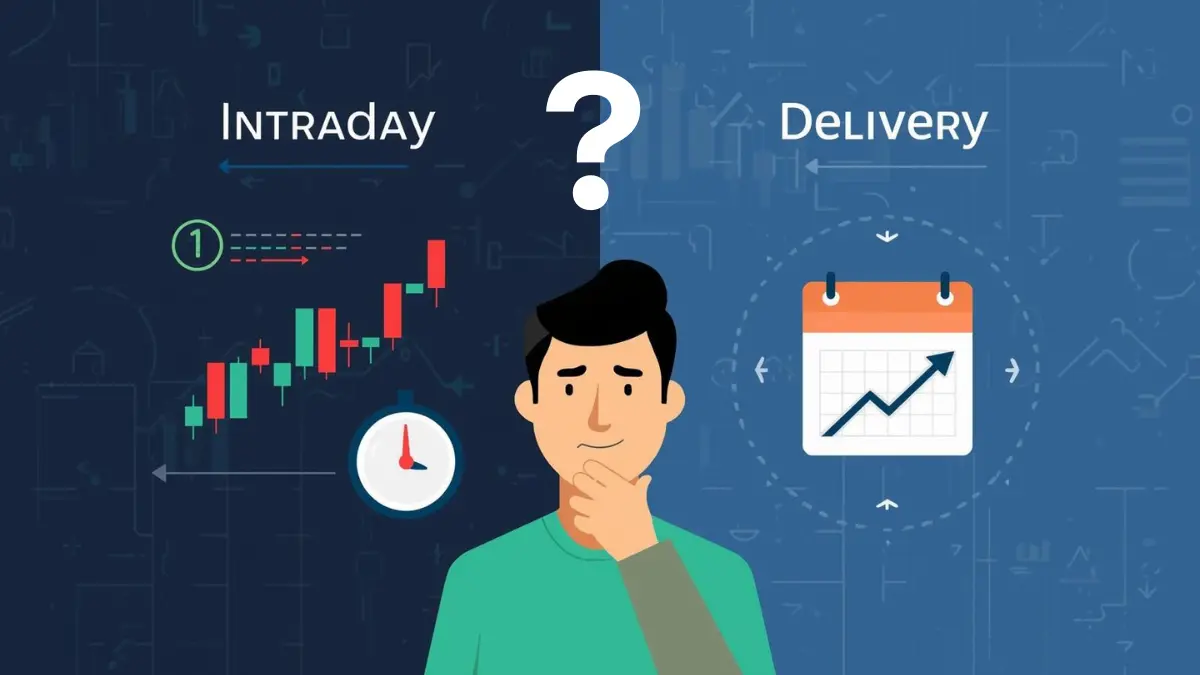
Confused between intraday vs delivery trading? This article explains intraday or delivery which is better for beginners, covering risk, benefits, and practical suitability.
If you are new to the share market, this question has probably crossed your mind. Many people are attracted to intraday trading because of the possibility of quick profits, while others consider delivery trading a safer option. However, choosing the wrong trading method without proper research and knowledge can lead to losses, especially for beginners.
In this article, we will explain in simple language the difference between intraday trading and delivery trading, along with their pros and cons, risk levels, and which option is more practical and safe for new investors. If you want to start your share market journey the right way, this Delivery vs Intraday Trading guide will help you make a clear decision and understand which option is better for beginners intraday or delivery trading.
Difference Between Intraday and Delivery Trading In Option
The main difference between intraday trading and delivery trading lies in time and ownership. In intraday trading, shares are bought and sold within the same trading day. Traders do not actually hold the shares; instead, profits or losses are based on short-term price movements. Because of this, intraday trading requires quick decision-making and regular market monitoring.
On the other hand, in delivery trading, shares are purchased and held in your Demat account, whether for a few days or for the long term. Here, you have actual ownership of the shares, and along with price movements, a company’s fundamentals also play an important role. Delivery trading is generally considered more stable for beginners, as it involves less daily pressure compared to intraday trading.
In simple terms, intraday trading focuses on the short term, while delivery trading is more suitable for a long-term approach. Both options differ in terms of risk level, capital requirement, and time commitment, which is why beginners should choose the one that best matches their comfort level and understanding.
Intraday or Delivery: Main Differences Every Beginner Should Know
| Factor | Intraday Trading | Delivery Trading |
|---|---|---|
| Basic Meaning | Buying and selling shares on the same trading day, with all positions squared off before market close. | Buying shares and holding them for several days, months, or even years based on long-term expectations. |
| Holding Period | Only for the same day | Short-term to long-term |
| Risk Level | High, as prices can move sharply within minutes or hours. | Moderate, since short-term market fluctuations usually smooth out over time. |
| Capital Requirement | Appears lower due to margin, but losses can add up quickly. | Requires more capital, but without margin-related pressure. |
| Margin / Leverage | High leverage is available, which increases both profits and losses. | Generally no leverage in CNC trades. |
| Stress Level | High, as constant price monitoring is required during market hours. | Low, since decisions are not based on minute-by-minute movements. |
| Time Commitment | Requires full attention during trading hours. | Only periodic review is usually enough. |
| Brokerage & Charges | Higher overall, due to frequent buying and selling. | Lower, as trades are less frequent. |
| Skills Required | Strong technical analysis and quick decision-making skills. | Basic market understanding and patience. |
| Emotional Pressure | High, as fear and greed can impact decisions quickly. | Lower, as a long-term view helps reduce emotional reactions. |
| Suitable for Beginners | No, usually not recommended | Yes, a safer starting option |
From the table above, you can easily see how intraday and delivery trading differ in terms of risk, time, and ownership. Pick the one that suits your trading style and level of experience.
Intraday Or Delivery: Which Is Better For Beginners
For beginners, delivery trading is usually a safer and more practical choice. Intraday trading requires fast decisions and constant market monitoring — the faster you try to make money, the faster you can lose it too. That’s why you need to stay fully focused on the market. In contrast, with delivery trading, you can buy shares and hold them in your Demat account. This gives you actual ownership and enough time to learn the market without facing daily pressure.
Intraday trading can still be profitable if you have the right skills, experience, and time to closely monitor price movements. However, if you are new to the share market or have only basic knowledge, your primary focus should be on understanding the basics, studying company fundamentals, and building confidence.
In simple words, if you are a beginner, you should focus on stability and learning rather than chasing quick gains, making delivery trading a more suitable option for you.
Capital Requirement: Intraday vs Delivery
As you already know, in intraday trading, shares are bought and sold within the same day, so the initial capital required is comparatively lower. Many brokers provide leverage, allowing you to trade more shares with a smaller amount of capital. However, leverage also means higher risk, as even a small price movement can increase your losses.
On the other hand, in delivery trading, you hold the shares in your Demat account, so you need to invest the full capital. For example, if you buy 100 shares, you have to pay the total cost in your account. Delivery trading does not offer leverage, but the risk is relatively lower, and you can benefit from long-term growth.
Short Example
- Intraday: Buy 100 shares at RS 200 → total investment RS 20,000, or you can use leverage to trade with less capital.
- Delivery: Buy 100 shares at RS 200 → total investment RS 20,000, fully paid, held in your Demat account for the long term.
When Should Beginners Try Intraday Trading?
Beginners should consider intraday trading only when they have basic trading knowledge, confidence, and some market experience. If you are a new investor and are not yet comfortable with reading daily charts, understanding price movements, or following short-term trends, intraday trading can be risky.
Ideally, you should first gain experience through delivery trading or long-term investing. This helps you understand market behavior and build confidence in your decisions. Since intraday trading requires quick decision-making and proper capital management, it is safer for beginners to start with small trades or practice using a demo account before investing real money.
Common mistakes beginners make
Many people enter the market in the hope of making quick profits and start intraday trading without proper knowledge. When they lack an understanding of charts, risk management, or market behavior, it often results in losses.
Another major mistake is putting too much money into a single trade. Many beginners risk a large portion of their capital in one trade, which increases the chances of heavy losses. Not using a stop-loss and trading based on emotions such as fear or greed also makes the situation worse.
One of the biggest and most common mistakes beginners make is overtrading or following tips without proper research. Successful trading requires patience, discipline, and continuous learning. By avoiding these common mistakes, you can protect your capital and gradually build confidence in the market.
Conclusion
Both intraday and delivery trading have their own pros and cons, as discussed in this article. However, when it comes to intraday or delivery which is better for beginners, the answer is delivery trading. Delivery trading is considered safer for beginners because it involves lower risk, provides better learning opportunities, and supports a long-term approach.
Disclaimer: This article is for educational purposes only. Share market investments are subject to market risks, so before starting intraday or delivery trading, do your own research or consult a certified financial advisor.